



The order says Linen shirt, sage, M. The shelf holds sage in S, M and L, folded alike, with the size on a tag inside the collar. The M pile has an L on top, because yesterday's return went back in a hurry. The packer has thirty orders to go before the courier comes and takes the top shirt. Nobody did anything unusual, and the customer receives a large.
This article is about stopping that parcel: how often it happens, what it costs under EU law, why mispicks happen, how barcode scan verification works and what it cannot catch, what you need before switching it on, and how to measure it.
How often it happens
There is one official, EU-wide number, and it needs reading carefully. Eurostat's annual survey on ICT usage in households asks people who bought online in the previous three months whether they had a problem, and one of the listed problems is a “wrong or damaged good/services delivered”. S1 The 2025 survey drew on around 330,000 individuals aged 16 to 74. S2
| Wrong or damaged item delivered | Any problem | |
|---|---|---|
| European Union | 10.36% | 35.43% |
| Estonia | 6.16% | 26.02% |
| Lithuania | 4.72% | 21.35% |
| Poland | 4.18% | 20.62% |
| Latvia | 2.52% | 13.27% |
Eurostat dataset isoc_ec_iprb21, 2025: share of individuals who bought online in the last three months who reported the problem in that period. S1 Annual ICT usage survey, around 330,000 individuals aged 16 to 74. S2 Self-reported. Wrong and damaged goods are a single answer.
Three limits apply. Wrong and damaged goods are one answer, so a parcel crushed by the carrier counts the same as a wrong size. It counts people over three months, not parcels. And it is self-reported. Read it as a ceiling on how many shoppers met a wrong item, not as an error rate to compare with your own. Even so, the Baltic and Polish figures sit well below the EU's 10.36%. S1
Customers who received one remember something more specific. In a 2022 survey of about 500 US consumers commissioned by Voxware, a seller of voice-picking software, 48% reported returns triggered by the right item in the wrong size or colour, and 41% by the wrong item altogether. S3,S4 It is a vendor's survey, US only, and respondents could name several triggers. The pattern is the useful part: the typical wrong item is not a random product. It is the neighbour of the right one.
What a wrong parcel costs
A wrong item is a return, so everything in the real cost of a return applies. Two things make it worse than a return the customer chose. The first is who pays, because EU law treats the two cases differently.
| The customer changed their mind | You sent the wrong item | |
|---|---|---|
| The rule | Right of withdrawal, Directive 2011/83/EU S5 | Lack of conformity, Directive (EU) 2019/771 S6 |
| What went wrong | Nothing: the customer may withdraw within 14 days “without giving any reason” S5 | The goods are not “of the description, type, quantity and quality” the contract requires S6 |
| Shipping it back | The customer pays, if you told them before purchase S5 | You pay: the remedy is “free of charge”, postage and carriage included S6 |
| What the customer gets | A refund within 14 days, delivery costs included S5 | Their choice of repair or replacement, then a price cut or termination if that fails S6 |
| The sale | Gone | Kept, if the replacement satisfies, after paying to ship twice |
A reading of the two Directives, not legal advice; both are applied through national law with national detail. The last row is reasoning.
The Sale of Goods Directive leaves little room. Repair or replacement must be carried out “free of charge”, defined as “free of the necessary costs incurred in order to bring the goods into conformity, particularly the cost of postage, carriage, labour or materials”, and “the seller shall take back the replaced goods at the seller's expense.” S6 It has applied since 1 January 2022 S6 through each country's own law. This is a reading, not legal advice, and a parcel holding an entirely different product could be argued as a failure to deliver instead. Check your own market's rules before your returns policy says anything else.
The second is that a wrong item breaks the stock count twice. Ship an L instead of an M and the system thinks the M left while the L is still on the shelf, so the next order for the last L becomes a cancellation or a substitution. That is reasoning from how stock is counted, not a measured effect.
On the shop's side alone, the lines add up like this:
- The first shipment, wasted. You paid the carrier to deliver the wrong thing.
- The return label. Yours, by the Directive's definition of free of charge. S6
- A second pick, pack and label, at full price and in a hurry.
- Receiving the wrong item and correcting stock on two variants.
- Support time and goodwill. In the Voxware survey, 37% of consumers affected by retailer errors said they expect “some sort of compensation”. S3
- The item that never comes back, when the return label would cost more than the item.
There is no European total. The most traceable published figure comes from a survey of 250 supply chain, warehouse and distribution managers in the US, UK, France and Germany, run in late 2012 for Intermec, a developer of mobile data-capture solutions: “a single mispick costs a warehouse approximately $22”. S7 Vendor-commissioned, fourteen years old and sized for a distribution centre, it is an order of magnitude at best.
Then there is the customer. In the same Voxware survey, 70% said they expect an incorrect order to be corrected and redelivered within three to four days, 29% of those who had returned something after a retailer error got a wrong item a second time, and 81% said two or three incorrect orders would make them stop shopping with a retailer. S3,S4 Those are stated intentions of US consumers in a vendor's survey. The 29% is the one to remember: the process that picked the wrong item also picks the replacement.
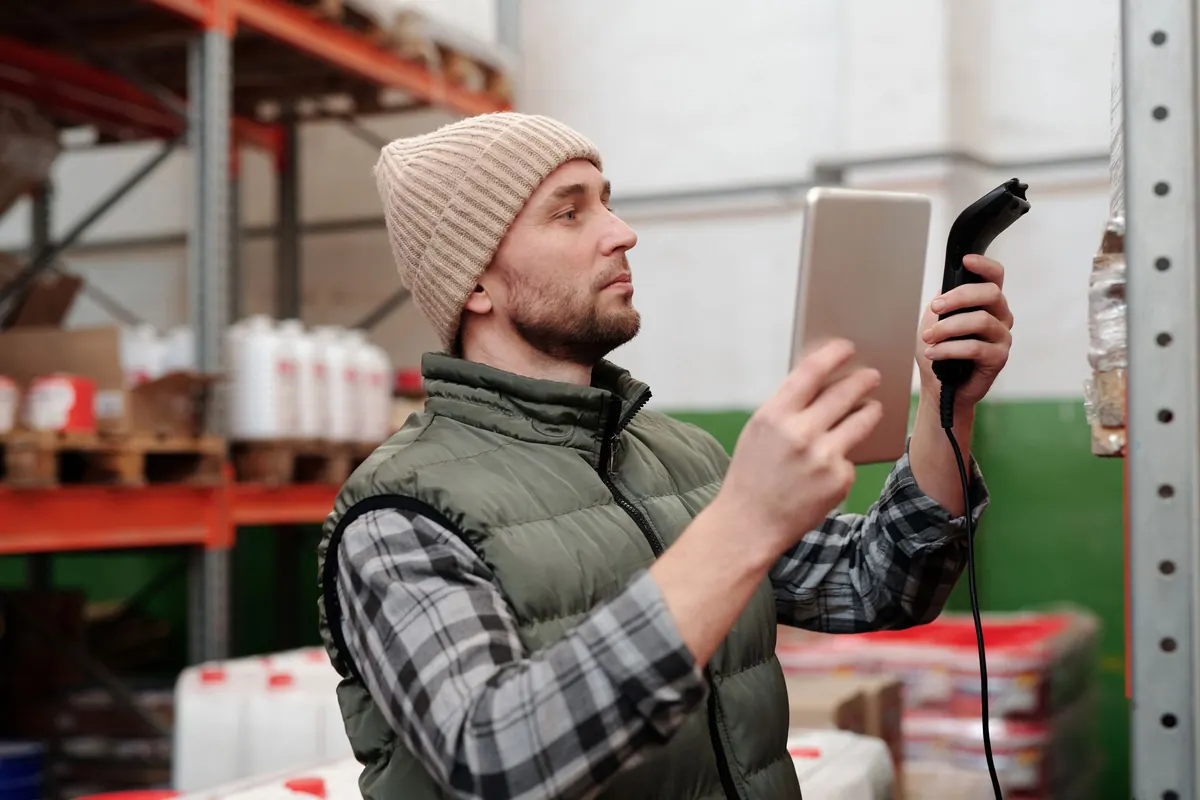
Why mispicks happen
Most wrong items are not carelessness. They are a person matching a line of text to an object by eye, hundreds of times a day, at speed. A study published in 2021 combined a review of 46 papers on manual order picking with interviews of 38 order pickers at 14 companies in four countries. The papers named eight failure modes: physical workload, physical fatigue, mental fatigue, complexity, memory demand, vision, hearing and motivation; the interviews added communication and supervision. S8 It studied warehouse pickers and its summary does not rank the causes, but every one of them turns up at a small shop's packing table on a busy day.
- Variants that look alike. A size run on one shelf is the same picture five times, and a shade or a 250 g label is easy to miss. Matching by eye fails where the difference is smallest, which fits the 48% of return triggers in the Voxware survey that were the right item in the wrong size or colour. S3
- Stock without its own code. An item with no barcode can only be checked by reading, and one whose barcode is shared across sizes cannot be checked at all. GS1, the standards body behind retail barcodes, puts it plainly: “If you use the same number for all the T-shirts, you won't know which colour to send to your customer.” S9
- Memory and interruptions. An order read once and picked from memory, a phone call between the shelf and the bench. Memory demand and communication are both on the research list. S8
- Quantities. A line that says “3 ×” read as one, or identical units counted by eye.
- Returns put back wrong. A returned item goes onto the nearest shelf, and the next pick from that shelf inherits the mistake.
- Substitutions. The right variant is out and the nearest one is in. A swap nobody agreed to is a wrong item with good intentions.
- New people and busy weeks. Fatigue is on the research list S8, and a peak week brings in people who have never seen the range.
What the shelf alone can fix
Keep look-alike variants apart or divided, with the size or colour printed large on the front of the bin. Put a photo beside order lines that differ only by shade. Give returns their own shelf until someone has checked them. None of these is a control, though: each depends on someone looking carefully, in exactly the conditions that make people look less carefully.
How scan verification works
Scan verification turns the packer's judgement into a comparison a machine makes. The order becomes a list of expected codes and quantities. A scan of a code that is on the order and still needed counts; a scan of a line that is already complete, or of a code that is not on the order, is refused, and the packer is told why. The order can only be finished when every line is complete, and the label should print at that moment, not before. Some systems also scan the printed label, which checks that the right label went on the right box.
Its limits follow from that: it checks codes, not objects, and only the codes that are actually scanned.
| Error | Caught? | Why |
|---|---|---|
| Wrong product | Yes | Its code is not on the order |
| Wrong size or colour of the right product | Only if every variant has its own code | Variants that share a barcode look identical to the scanner S9 |
| Missing item | Yes | The order cannot be completed |
| One unit too many or too few on a multi-unit line | Yes, if every unit is scanned | One scan with a typed quantity checks one unit |
| Item put in the box without a scan | No | The check covers scans, not the contents of the box |
| Item carrying the wrong barcode label | No | The scanner trusts the label |
| Damaged item | No | A barcode says nothing about condition |
| Right parcel, wrong shipping label | Only if the label is scanned against the order | Otherwise nothing checks the label |
Reasoning from how the check works, not measured results.
The multi-unit row matters most, and the clearest evidence for it comes from a field next door. A hospital pharmacy filling medication orders is doing order picking with higher stakes. In a before-and-after study at the pharmacy of one 735-bed academic medical centre, published in 2006, observers checked 115,164 dispensed doses before barcode scanning was introduced and 253,984 after, across three set-ups of the same system. S10
One hospital pharmacy, before and after barcode scanning
93–96%
Fewer target errors, every dose scanned
Relative reduction in target dispensing errors in the two set-ups that required staff to scan all doses. S10
60%
Fewer target errors, one scan per batch
Relative reduction in the set-up where only one dose was scanned when several doses of the same medication were dispensed. S10
2.4×
More potentially harmful errors, one scan per batch
In that same set-up, target potential adverse drug events rose 2.4-fold. S10
Poon et al., Annals of Internal Medicine, 2006: one hospital, observed doses, surrogate outcomes, assessors not masked to the study's purpose. S10 An analogy for a design choice, not a forecast for a shop's error rate.
The size of the effect belongs to the pharmacy, not to you. The lesson travels, and the authors drew it themselves: the technology “should be configured to scan every dose”. S10 A scan that stands for several units is a guess with a beep attached.
At picking or at packing?
Both if you can; packing if you can only do one, because it is the last point before the box closes and catches a wrong item whoever picked it. Scanning at picking catches the same error earlier and saves the walk back to the shelf, and it earns its place once orders are picked in batches. That is reasoning, not a measured comparison.
Is weighing the parcel enough?
A check weight can catch a missing or extra item that is heavy enough to register. It misses the swap that matters most here: an M and an L of the same shirt weigh nearly the same. Weighing can sit beside scanning. It cannot replace it.
What you need first
Scan verification is cheap to switch on and useless without its inputs. Five things have to be true first.
- Every sellable variant has its own code: every size, colour and pack size, not just every product. GS1's rule for retail barcodes fits your own codes too: “Each product variation needs its own GS1 GTIN™”, where variations means “each size, each colour, each combination of sizes and colours”. S9 Fix blanks and duplicates first; why every product needs a SKU covers how to design codes and add them to a live shop.
- The code sits in the field your scans match on. Shopify's help centre says “SKUs are different from barcodes and are used for different purposes” and keeps them in separate fields. S11 Pick the one your scans match against and fill it on every variant, not only the parent product. Shopify asks the same of SKUs: “Each product and variant must have its own unique SKU.” S11
- Every unit carries a readable code. Supplier barcodes cover most branded goods. For own-brand, handmade or bundled items, your SKU printed as a barcode label is enough inside your own warehouse. Check that labels survive the shelf: in a study of barcode workarounds at five hospitals, the causes included “unreadable medication barcodes (crinkled, smudged, torn, missing, covered by another label)” and “nonbarcoded medications”. S12
- A scanner, and a spare. A USB or Bluetooth scanner at the packing screen, or a phone camera, depending on volume, plus a charged battery: “malfunctioning scanners” and “failing batteries” were on the same hospital list of reasons people stopped scanning. S12
- Orders that describe what goes in the box. A gift set sold as one line but packed from three components needs either its components on the order or its own label. Anything that goes into the box without an order line, like a free sample, is invisible to the check.
Rolling it out
The technical part of switching on scan verification takes an afternoon. The first month decides whether it works.
- 1
Count before you change anything
Record every wrong, missing or extra item that reaches a customer for four weeks: the order, the SKU and how you found out. Without a baseline you cannot tell whether the change worked.
- 2
Audit the codes
Export the catalogue and find variants with no barcode, and barcodes or SKUs used twice. Then scan one physical unit of every variant on the shelf and check that it finds the right one.
- 3
Label what has no code
Print labels for everything the audit flagged, and label the bin as well where items are small. Returns are checked and labelled before they go back on a shelf.
- 4
Scan every unit
Do not let one scan stand for a whole line: three identical units are three scans. This is the design choice the pharmacy study measured. S10
- 5
Make the exception visible
Every system needs a manual confirm for a label that will not scan. Count how often it is used, and on which products. In the five-hospital study, nurses overrode barcode alerts for 10.3% of medications charted. S12 A manual confirm that becomes routine is a scan that has stopped happening.
- 6
Fix the shelf, not the person
Review the refused scans every week. When the same two variants keep being swapped, the fix is in how they are stored or labelled.
Measuring accuracy
“Accuracy” means nothing until you say what is counted, and per what. In the 2012 Intermec survey, 52% of the 250 managers reported a pick accuracy below 97%, and 19% did not measure the cost of mispicks in any way. S7 The report never says whether accuracy was counted per order, per line or per unit, which is exactly the ambiguity to avoid. It was a vendor's survey of distribution centres: evidence that measurement is patchy, not a benchmark.
For a shop packing its own orders, two numbers are enough. Count both per order, because an order is what the customer receives.
| Number | How to count it | What it tells you |
|---|---|---|
| Wrong items shipped | Orders that reached the customer with a wrong, missing or extra item, per 1,000 orders shipped | What customers experience. The number that has to fall. |
| Wrong scans refused | Orders where the bench refused at least one scan, per 1,000 orders packed | Where picking goes wrong, by product. Each one is a mistake that did not ship. |
Count per order; break down by SKU and by person only to find causes. Reasoning, not a published standard.
The first number comes from return reasons and support messages, so give “wrong item received” its own return reason and its own tag in the inbox. It will undercount, because some customers keep a near miss and say nothing, so treat the baseline you count before scanning as a floor, not the real figure. That is reasoning, not a measured rate.
Read the second number the right way round. In the first weeks it should be high, because the bench is now refusing mistakes that used to ship. Refusals that fall while wrong items shipped stay near zero mean picking is improving; zero refusals from the first day more likely mean the check is being bypassed than that nobody makes mistakes. Both readings are reasoning. And compare neither number with the Eurostat table: that one counts people over three months S1, yours counts orders.
None of this needs a warehouse system to start. It needs one code per variant, a label on every unit, a scanner at the bench and a rule that every unit gets scanned. The parcel with the L in it was not a people problem. It was a check that was not there.