



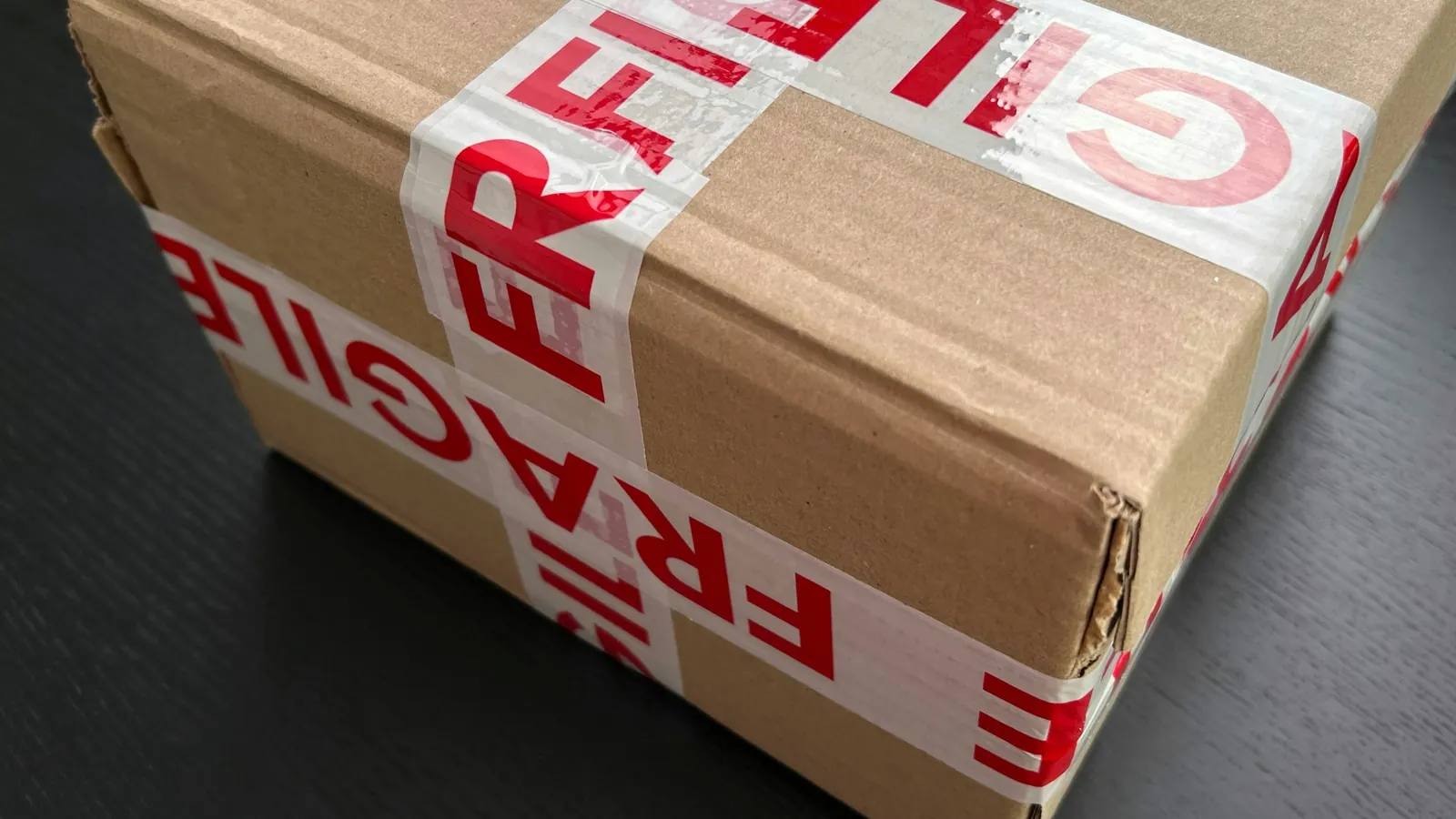
A customer writes to say the parcel has not arrived, or sends a photo of a crushed box. Two questions follow, and stores tend to answer them as one. What do you owe the customer? And what does the carrier owe you? The first is decided by consumer law and has to be answered within days. The second is decided by your transport contract, takes weeks, and is capped at an amount that often has little to do with what was in the box.
This article takes them in that order. It is written just after Black Friday, when the parcels sent at peak either arrive or do not; the preparation is in our Black Friday fulfillment checklist. Every carrier figure comes from that carrier's published terms for the country named, read on 27 November 2026. Your own contract may differ, and it is the one that counts.
What you owe the customer
In the EU the rule is one sentence of the Consumer Rights Directive, 2011/83/EU. Article 20: “the risk of loss of or damage to the goods shall pass to the consumer when he or a third party indicated by the consumer and other than the carrier has acquired the physical possession of the goods.” S1 Handing the parcel to the courier changes nothing between you and the customer. Until the customer, or a person the customer named, is holding it, a lost or broken parcel is your loss.
There is one exception, and it rarely fits an online store. The risk passes on handover to the carrier “if the carrier was commissioned by the consumer to carry the goods and that choice was not offered by the trader”. S1 As we read those words, a customer who picks a carrier at your checkout has chosen an option you offered; the exception covers the buyer who sends their own courier to collect.
Article 18 sets the clock. Unless you agreed another time, you must deliver “without undue delay, but not later than 30 days from the conclusion of the contract”. If you do not, the customer sets an additional period “appropriate to the circumstances”, and if that passes too they may end the contract and you must “without undue delay, reimburse all sums paid”. S2 For goods that arrive damaged, the EU's own summary for consumers says the trader “is responsible for any damage to your goods from the time they are dispatched until you receive them”, and the customer can ask for a repair or a replacement, or a price reduction or refund where neither is possible. S3
The UK kept the same rule after leaving the EU. Under section 29 of the Consumer Rights Act 2015 the goods “remain at the trader's risk until they come into the physical possession of” the consumer or “a person identified by the consumer to take possession of the goods”, with the same exception for a carrier the consumer commissioned who “is not a carrier the trader named as an option”. S4 Section 28 gives the same 30 days, the same further period and the same refund “without undue delay”. S5
Nothing in either text makes the customer's remedy wait for the carrier's investigation. So the working order is: replace or refund first, claim from the carrier afterwards. Citizens Advice tells consumers in England the same from their side: “If the seller used a courier, they should chase the courier to find out what's happened to your order - it's not your responsibility.” S6 What a customer may send back for other reasons is a separate rule: see the 14-day right of withdrawal.
What the carrier owes you
Between you and the carrier there is no consumer law, only the contract of carriage and whichever transport law governs the journey. Which law that is depends on how the parcel actually travelled.
| Rules | Apply to | Limit for loss or damage | Notice of damage |
|---|---|---|---|
| CMR Convention S7 | International carriage by road, where at least one of the two countries is a contracting state | 8.33 SDR per kg of gross weight lost, plus the carriage charges and customs duties | At delivery if the damage is visible; in writing within 7 days of delivery if it is not, Sundays and public holidays excepted |
| Montreal Convention S8,S9 | International carriage by air between states that are party to it | 26 SDR per kg since 28 December 2024 (17 in the 1999 text) | In writing, within 14 days of receipt |
| German Commercial Code, sections 431 and 438, as an example of national law S11 | Carriage within Germany | 8.33 SDR per kg of gross weight | At delivery if the damage is visible; within 7 days of delivery if it is not, in text form |
| Postal rules | Items carried as post: CMR excludes carriage under an international postal convention, and the Montreal Convention excludes postal items S7,S8 | The postal operator's own scheme. Royal Mail International Tracked on account: up to £100, or market value if lower S21 | Royal Mail: by the sender, within 180 days of posting S21 |
The conventions were read from the Schedules to the UK Acts that reproduce them, and the Commercial Code in the German justice ministry's English translation, checked against the German text.
The limits are counted in SDR, the Special Drawing Right, the International Monetary Fund's unit of account. On 25 November 2026, the latest rate published when this was written, the IMF put one SDR at €1.227020 and £1.027290. S10 That makes the road limit about €10.22 a kilo and the air limit about €31.90: a 2 kg parcel lost on an international road service is worth about €20.44 under the convention, and about €63.81 by air, whatever was inside. A court converts at the rate on the day of its judgment. S7
A late notice does not cost the same everywhere. Under CMR and the German code the claim survives, but the parcel is presumed to have arrived complete and undamaged and you have to prove otherwise. S7,S11 Under the Montreal Convention, if no complaint is made in time, “no action shall lie against the carrier”, save for fraud on its part. S8 Some carriers' own terms are stricter than either: after its 30 days, DHL Express has “no liability whatsoever”. S12
The conventions also say what is not paid. Under CMR the carrier refunds the carriage charges and customs duties on a total loss, “but no further damages shall be payable”. S7 Carriers' terms say the same: DHL Express excludes lost profits, and GLS “loss of profit, loss of sales or expenses of substitute performances”. S12,S20 The replacement you sent, the second postage and your margin stay with you.
Two things move the limit. A value declared to the carrier before shipping, against a surcharge, replaces it (Article 24 of CMR, Article 22 of the Montreal Convention). Under CMR the limit also falls away for the carrier's wilful misconduct; the Montreal Convention's equivalent rule covers passengers and baggage, not cargo. S7,S8 One thing removes the liability altogether: packing. CMR relieves the carrier where damage arises from “the lack of, or defective condition of packing” of goods that need it, and the Montreal Convention for “defective packing” done by anyone but the carrier. S7,S8 In court, CMR allows one year to bring a claim and the Montreal Convention two. S7,S8
Standard liability and claim deadlines at nine carriers
Parcel carriers write these regimes into their terms, and some add a fixed amount per parcel. The table gives nine carriers' standard terms, each for one country.
| Carrier and country of the page | Standard liability | Report damage or loss within | Who claims | Source |
|---|---|---|---|---|
| DHL Express (UK) | The lower of the goods' value and 26 SDR per kg by air (about €31.90) or 8.33 SDR per kg by road (about €10.22) | 30 days from the date DHL accepted the shipment, for damage and for loss | The shipper, “in almost all situations” | Terms, undated; claims guide, December 2024 S12,S13 |
| FedEx (UK site: conditions for Europe, plus an annex for shipments within the UK) | International: the limit of the applicable convention, and never more than the repair cost, depreciated value or replacement cost. Within the UK: the lowest of the goods' cost to their owner, the repair cost and £12 per kg, and nothing where that comes to less than £20 | International: damage or missing contents within 21 days after delivery, loss within nine months of handover. Within the UK: in writing within 28 calendar days of delivery for damage, or of collection for loss | “The claimant”; nobody whose parcel reached FedEx through a consolidator | Conditions effective 15 January 2026; UK annex effective 31 March 2025 S15,S31 |
| UPS (UK; the same terms cover Ireland, Denmark, Finland, Norway and Sweden) | The convention limits where they apply; otherwise the greater of £60 per shipment and 8.33 SDR per kg | Damage: 14 days of receipt. Loss: 60 days of handing the goods to UPS | A recipient may start a claim; payment goes to the shipper of record | Terms linked from UPS UK's terms page, a PDF headed “2024 UPS Tariff Guide”; limits repeated in the UK service guide effective 7 June 2026 S17,S30,S18 |
| DPD (Germany, DPD CLASSIC terms) | Up to €520 per parcel from liability and DPD's insurance together, limited to the purchase value you can prove | Not stated in the terms. German law: at delivery for visible damage, within 7 days of delivery for hidden damage | The sender: the insurance is for the sender only, and claims cannot be assigned | June 2026 S19,S11 |
| GLS (Germany, business customers) | The sender's purchase price, up to €750 per parcel, where the sender has no transport insurance of its own | “The statutory regulations”: German law, as for DPD | Not stated; the terms address the sender | January 2025 S20,S11 |
| Royal Mail (UK, account customers, Tracked 24 and 48) | Actual loss at cost price, up to £150, or market value if lower | 30 calendar days of the eligible claim date; a loss claim opens 7 working days after the due date | The account holder; recipients are told to contact the sender | Undated S21,S22 |
| InPost (Poland, Paczkomat 24/7) | The ordinary value of the items; InPost recommends added protection above PLN 200 | Visible damage: at delivery. Damage not visible from outside: 7 days. Any complaint: within 12 months of posting | The sender; the recipient once the parcel is delivered, or if the sender waives | In force from 10 November 2026 S23 |
| DHL Paket (Germany) | Up to €500 per parcel within Germany | Damage or missing contents: 7 days of delivery. Loss: not stated | Not stated | Undated S24,S25 |
| Evri (UK, parcels booked on evri.com) | The lesser of £20 and the repair cost or value of the goods | Business senders: 28 days from the order date, 45 days for international | The sender | Undated S26,S28 |
Read on 27 November 2026 from each carrier's published standard terms or help pages for the country shown. “Not stated” means the pages read do not say. Negotiated contracts, other countries and other services can differ. DPD's wording is our translation from German and InPost's from Polish; GLS's English text is its own convenience translation, and the German version binds. DHL Paket's seven days are from its help page for private customers. SDR amounts are at the IMF's rate for 25 November 2026. S10
Three things stand out. First, the amounts are of two kinds. The express carriers pay by the kilo, so a light, expensive parcel is the worst case. The parcel networks pay up to a ceiling, from £20 at Evri to €750 at GLS in Germany, and anything above it is uncovered unless you arrange more. S26,S20 Second, the clocks start on different days: acceptance at DHL Express, delivery at FedEx and UPS for damage, the order at Evri. S12,S15,S17,S26 A parcel that goes missing quietly can use up most of a 28 or 30 day window before anyone looks.
Third, where the terms say how value is counted, it is your cost, not your price. Royal Mail defines actual loss as “what the item cost you to acquire, purchase or manufacture”: jeans sold for £25 that cost the shop £15 are a £15 claim. S21 DHL Express tells manufacturers and suppliers to claim “the wholesale or manufactured cost (i.e. your cost), NOT the retail value of the item”. S13 DPD and GLS in Germany pay the purchase value, as the table shows. S19,S20 A claim paid in full still does not return the margin.
When extra cover pays for itself
There are three ways to be covered above the standard amount, and they are not the same product.
- A declared value. You state a value when you book and pay a surcharge, and the carrier's own liability rises to it. FedEx and UPS work this way: FedEx “does not provide a cargo all-risks insurance” but lets the sender pay to declare a value for carriage S15; UPS takes a higher value on the waybill for a charge that its UK service guide, in the edition effective 7 June 2026, sets at 1% of the declared value with a minimum of £11.50. S17,S30
- Insurance arranged by the carrier. A policy sold with the label. DHL Paket in Germany insures a parcel up to €2,500 for €6.99, or up to €25,000 for €19.99, on top of the postage, and unlike its liability the insurance pays where DHL was not at fault, “for example in cases of force majeure (such as fire or storm)”. S24 DPD in Germany offers up to €13,000 a parcel for a premium S19, InPost protection in bands up to PLN 20,000 S23, Evri cover up to £999 S28, and DHL Express insurance for “100% of the value”. S14
- Third-party insurance. A policy from an insurer, often sold through shipping software. Sendcloud describes its own as “a third party” that pays on “the sales or purchase value of your shipment, instead of per kilo”. S29
Of the pages read, only DHL Paket's and UPS's publish a price; the others point to a rate sheet, a price list or a quote. Read the conditions before relying on any of them. Bad packing voids insurance as surely as liability: DHL Paket gives no assurance of cover for “inadequately packaged parcels”, and DHL Express says its insurance generally does not cover “insufficient or unsuitable packing”. S24,S14 DHL Paket's insurance does not apply to a parcel dropped at a Packstation. S24 DHL Express's is “subject to the conditions of average”: insure a parcel for less than it is worth and a loss is paid only in proportion. S13 And cover can cancel cover: DPD's German terms exclude from its own insurance any parcel insured elsewhere, even where the other policy falls short, and GLS's €750 applies only “if the sender has not taken out transport insurance”. S19,S20
Whether cover pays is arithmetic. Take DHL Paket's prices and assume a total loss on which the standard €500 is paid in full. The €6.99 add-on is worth buying when the share of your parcels lost or destroyed, multiplied by the cost the €500 does not cover, exceeds €6.99. The three costs in the table are assumptions, not findings.
| Assumed cost of the goods to you | Not covered by the standard €500 | The add-on pays for itself if you lose more than |
|---|---|---|
| €600 | €100 | 7 parcels in 100 (6.99%) |
| €1,200 | €700 | 1 parcel in 100 (1.0%) |
| €2,500 | €2,000 | 1 parcel in 286 (0.35%) |
Our arithmetic on DHL Paket's prices for business customers in Germany, read 27 November 2026: €6.99 divided by the uncovered cost. S24 Assumed: a total loss, the standard €500 paid in full and the insurance paying the rest. It ignores partial damage and the events only the insurance covers.
We looked for a parcel loss rate with a method behind it to put into that sum and did not find one, so there is none here. Count your own: claims filed over your last few thousand parcels, carrier by carrier.
How to file the claim
The claim belongs to the party that has the contract with the carrier, which on your own carrier contract is you. DHL Express says that “in almost all situations it is only the shipper that may make a claim”, and UPS lets a recipient start a claim but sends the money to “the shipper of record”. S13,S18
Where a reseller or aggregator bought the label, the contract is theirs. Sendcloud's help centre states both halves: on its own rates it will “forward it to the carrier on your behalf”, while on a store's own contract “the claim has to be opened directly with the carrier, not with Sendcloud”. S29 FedEx's terms go further: “Senders or Recipients whose Packages were tendered to FedEx through a package consolidator do not have any right to legal or equitable relief against FedEx.” S15 The two routes are compared in aggregator or own contract.
- 1
Open a trace the day tracking goes quiet
Ask the carrier to investigate as soon as a parcel has gone longer without a scan than the service normally takes. The windows for a loss start at 28 days, counted from the order at Evri and from collection at FedEx within the UK; DHL Express allows 30 days from acceptance. S26,S31,S12 Work to the shortest that could apply.
- 2
Settle with the customer separately
Refund or re-send under the rules in the first section, and tell the customer what you need from them for the claim. Their refund does not wait for it.
- 3
Get the evidence while it still exists
For damage, ask the customer the same day to keep the item, the box and all the filler, and to photograph the box, the label and the damage. DHL Express requires goods and packaging to be “retained in the original shipping container at the receiver's location” for inspection, FedEx makes that a pre-condition of considering a damage claim, and DHL in Germany wants the parcel handed in “including all existing shipment components”. S13,S15,S25 Once the box is in the bin, those conditions cannot be met.
- 4
Give notice in writing, inside the deadline
Do not rely on a phone call: for damage found after delivery, CMR and the Montreal Convention ask for writing and German law for text form. S7,S8,S11 Send the notice even if the paperwork is incomplete: under FedEx's conditions for Europe the supporting documents can follow within nine months of handover. S15
- 5
Prove the value at cost
Send the supplier invoice or your cost calculation, not the order confirmation. Royal Mail wants proof of cost price that “should not include item sale price” S21; Evri asks for “the cost price of the Goods and related proof including receipts”. S26 UPS asks for a detailed description, down to brand, model and serial number. S18
- 6
Prove the handover
The carrier has to have received the parcel before it can have lost it. Royal Mail pays where “evidence of posting and value are provided” S21; Evri asks for “proof of the Parcel's dispatch” S26; FedEx accepts no liability for an item “for which FedEx has no verifiable record of receipt”. S15 The first carrier scan is that record. A label you printed is not.
- 7
Expect a refusal on two grounds above all. The first is packing: FedEx excludes “improper or insufficient packing”, DHL Express treats packaging that is “defective or inadequate” as unacceptable for carriage, and GLS excludes goods “which are insufficiently packed”. S15,S12,S20 The second is the contents. Evri carries glass, ceramics, laptops and artwork but lists them as excluded from compensation. S27 GLS excludes goods that are “particularly fragile”, any parcel worth more than €5,000, and watches and jewellery above €750 a parcel, and a sticker does not change this: GLS says it “has no means to provide a special handling”. S20

Delivered, but the customer says it is not there
The hardest case is the parcel the carrier says it delivered. Start with what the carrier recorded.
- A signature. FedEx shows “an image of the recipient's signature” S16; Royal Mail shows who signed, which “may not necessarily be the name on the address label”. S22 GLS in Germany takes a signature only on its SignatureService, on express deliveries or where agreed. S20
- A photo or a location. Royal Mail says most of its services come with a proof of delivery photo S22; Evri treats a photo of the parcel over the threshold, at a neighbour's address or in a safe place as proof of delivery S26; FedEx photographs residential parcels released without a signature, and its UK site describes GPS proof of delivery “showing the nearest coordinates to where your package was marked as delivered”. S16
- A name. DHL's German tracking shows whether the parcel went to the recipient, “a relative, a neighbour, or any other person” S25; DPD in Germany must tell the recipient the neighbour's name and address. S19
Ask the carrier for all of it in writing, and ask the customer to run Royal Mail's checklist: others in the household, neighbours, safe places, a card through the door, the address they gave you. Royal Mail adds that a same-day delivered scan may be “a rare scanning error” and asks for an extra day. To investigate, it wants the tracking number and “the recipient's confirmation that they haven't received it”, so get that from the customer by email. S22
Towards the customer, the rule from the first section still decides: the risk passes when the consumer, or a person they named, has physical possession. S1,S4 What follows is our reading of those words, not a ruling. A scan or a photo is evidence that the customer got the parcel, not the event itself. A neighbour the customer named fits both texts; one the customer never named or agreed to does not, on the face of them. Neither text mentions a safe place. For that there is only guidance: Citizens Advice tells consumers in England that when Royal Mail leaves an item with a neighbour or in a certain place “because you told them to, it's not the seller or Royal Mail's responsibility if it gets lost”, and that without such an instruction “it's the seller's responsibility”. S6 How a court would weigh a doorstep photo against a customer's word is a matter for national law, and no case law was read for this article.
Towards the carrier, a delivery made on the customer's instructions ends the claim in the terms that address it. UPS says parcels the receiver chose to have released are “not eligible to be submitted for claims”, and its terms have the shipper waive any claim arising from UPS following the receiver's instructions. S18,S17 FedEx accepts no liability for complying with delivery instructions from the sender or the recipient. S15 Evri's definition of “Delivered” includes “left with a Neighbour or left in a Safe Place”. S26 On parcels you cannot afford to lose, use a service with a signature and rule out delivery to a neighbour: UPS, and DPD in Germany, let the sender exclude it. S17,S19
What to settle before the next parcel leaves
Most of what decides a claim happens before the parcel leaves.
- Pack to the carrier's published standard, not to your own judgement. DPD's German terms give the test: the packaging must protect the goods through automatic sorting and a drop of about 80 cm onto an edge, a corner or a side. S19 DPD and GLS in Germany take no account of markings such as “caution glass” or arrows, and FedEx accepts no liability for failing to honour orientation markings. S19,S20,S15
- Check the contents against the exclusions before you choose the service. Declare the value where the terms require it: DPD in Germany wants it stated on any parcel worth more than €520. S19
- Keep proof of handover. A collection scan, a signed manifest or a drop-off receipt. GLS says that sending it your parcel data is not “prima facie evidence” that the parcels “have actually been handed over”. S20 Check each evening that everything you labelled has a first scan.
- Watch for silence. A parcel with no scan for several days is a claim whose clock is already running. The article on order tracking covers how to spot one before the customer asks.
- Insure by rule. Set a value above which every parcel gets a signature and extra cover, and apply it when the label is created, not when someone remembers.
- Photograph what you cannot afford to argue about. A photo of the packed contents and the sealed box answers the packing question before it is asked. That is our reasoning, not a carrier's requirement.
The uncomfortable part is how little the two halves have to do with each other. What you owe the customer does not shrink because the carrier's cap is low, and the carrier's cap does not grow because you refunded in full. Treat the gap as a cost of shipping: pack to the standard, insure the few parcels that need it, and refund without waiting for an answer that would not change what the customer is owed.